The principle in one sentence
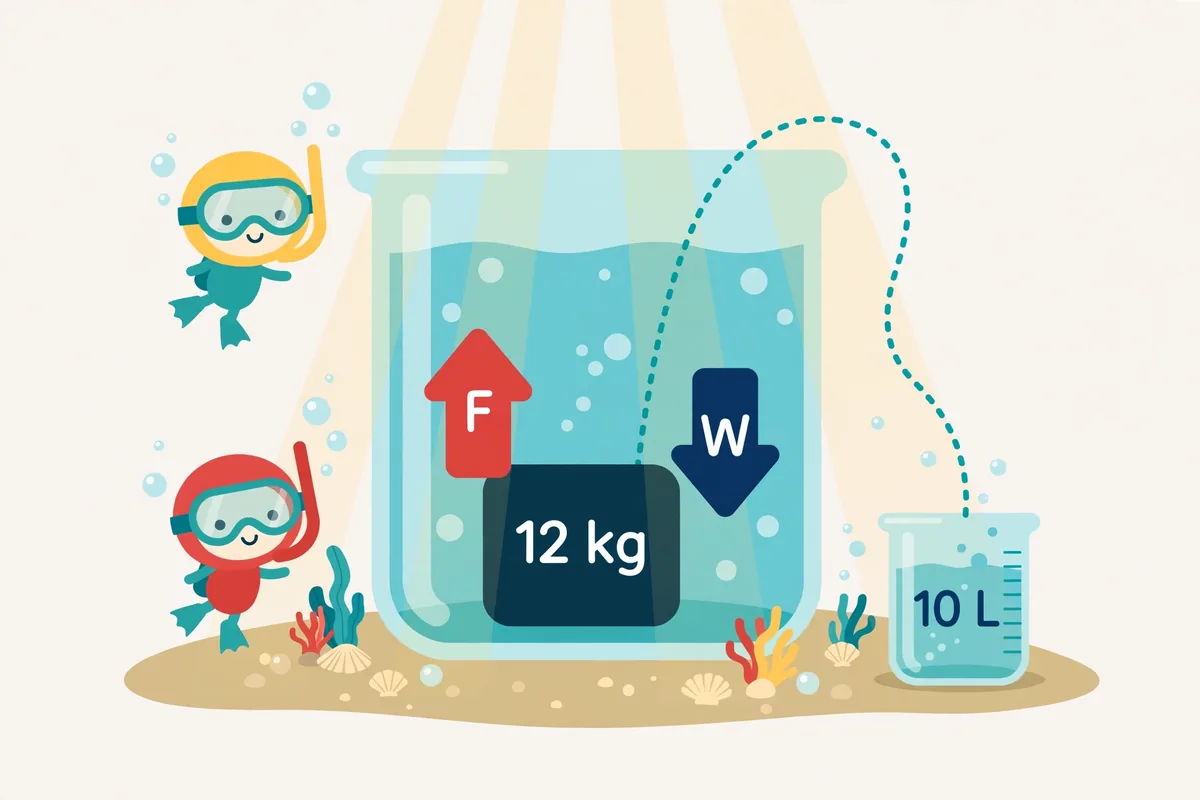
An object placed in a fluid is pushed upward by a force equal to the weight of the fluid that it displaces. That one idea explains why steel ships float, why a diver can hover, why seawater lets you float more than a lake does, and why the lead on your belt matters.
The story behind it
According to the traditional story, Archimedes was asked to find out whether a crown was made of pure gold. Stepping into a bath, he noticed the water rise and realised he could measure an irregular object’s volume by the water it displaced. Whatever the truth of the legend, the principle that carries his name is one of the oldest and most reliable laws of physics.
Why it works: a short derivation
You do not have to take the principle on trust. Imagine a block of height H and top area A, sunk so that its top surface is at depth h. Pressure in a fluid increases with depth: P = P0 + ρgh, where ρ is the fluid density and g is gravitational acceleration.
- The water pushes down on the top face with force [P0 + ρgh] × A.
- It pushes up on the bottom face, which is deeper, with force [P0 + ρg(h + H)] × A.
The surface pressure P0 cancels, and what remains is ρgV: the weight of a volume V of fluid, exactly the volume the block displaces. The side forces cancel because they are equal and opposite. The bottom is pushed up harder than the top is pushed down simply because it is deeper. That small difference is the buoyant force.
Sink, float or hover
| If the object’s average density is... | ...compared with the water | It will |
|---|---|---|
| Greater | Heavier per litre | Sink |
| Equal | The same | Hover (neutral) |
| Smaller | Lighter per litre | Float, partly out of the water |
The key word is average density. A steel ship is mostly air, so its average density is lower than water. A diver is a mixture of body, lungs, suit, tank and lead, and the weighting game is to make that average density equal to the surrounding water.
Densities worth knowing
| Material | Approximate density (kg per cubic metre) |
|---|---|
| Freshwater | 1,000 |
| Seawater | 1,025 |
| Human body, lungs full | about 960 to 1,000 |
| Human body, lungs empty | about 1,020 to 1,070 |
| Aluminum | about 2,700 |
| Steel | about 7,850 |
| Lead | about 11,300 |
The reason lead is used for dive weights is its density: a small, compact piece displaces little water but weighs a lot, so it adds a large downward force without adding much lift.
What it means for divers
Your body
With lungs full you are slightly less dense than seawater, so you float. Breathe out and your density rises above the water’s, so you sink slowly. That swing is what the buoyancy check uses.
Your wetsuit
Neoprene is mostly gas bubbles. As you descend, pressure squeezes the bubbles, the suit’s volume shrinks and, because the displaced volume is smaller, so is the buoyant force. A suit therefore lifts less at depth.
Your BCD
The opposite happens to the air in your BCD: as you rise, pressure falls and the air expands (Boyle’s law), displacing more water and adding lift. A BCD is a variable-volume device that lets you tune your displaced volume.
Your tank
A tank displaces the same volume of water whether full or empty, but the air you breathe leaves it, so it weighs less and becomes more buoyant. See tank weight and buoyancy.
The water
Seawater is about 2.5 percent denser than freshwater, so it pushes up about 2.5 percent harder on the same volume. That is why you need roughly 2 to 3 kg less lead in a lake. See freshwater vs saltwater.
Common misconceptions
- “Heavy things sink.” Not always: a steel ship floats. What matters is average density.
- “Buoyancy depends on depth.” For something incompressible, no. Divers feel depth effects because suits and gas spaces compress.
- “Lead increases weight but not buoyancy.” Lead also displaces a little water, but its lift is tiny compared with its weight.
Practice problems
- A 5 kg block displaces 3 L in freshwater. Does it sink? Lift = 3 kg. Apparent weight = 5 − 3 = 2 kg, so it sinks.
- The same block in seawater? Lift = 3.075 kg, apparent weight 1.925 kg: it still sinks, a little less strongly.
- A diver’s kit displaces 85 L in seawater and has a mass of 83 kg. Floats or sinks? Lift = 87.1 kg. Apparent weight = 83 − 87.1 = −4.1 kg, so it floats with 4.1 kg of lift.
Archimedes and ships
A solid steel block sinks, yet a steel ship floats. The ship’s hull encloses a large volume of air, so the ship as a whole displaces a huge amount of water for its weight. A ship floats when its weight equals the weight of the water its hull displaces, and it sits lower in the water as it is loaded because it has to displace more. Divers do the same thing on a small scale: your BCD lets you adjust your volume so that your displaced weight equals your own.
Solving for neutral buoyancy
To hover you need the total mass of you and your kit to equal the mass of the water you displace, so volume = mass ÷ water density. A diver with 100 kg of body, suit, tank and lead needs to displace about 97.6 L of seawater (100 ÷ 1.025) to be neutral. If the real displaced volume is 95 L, there is a shortfall of about 2.6 L, or roughly 2.7 kg of excess weight: you sink. Add 2.7 L of air to the BCD and you hover. This is the logic behind every weighting and buoyancy-control decision.
How pressure changes with depth
| Depth (seawater) | Absolute pressure | Volume of 1 L of air from the surface |
|---|---|---|
| 0 m | about 1 bar | 1.00 L |
| 10 m | about 2 bar | 0.50 L |
| 20 m | about 3 bar | 0.33 L |
| 30 m | about 4 bar | 0.25 L |
| 40 m | about 5 bar | 0.20 L |
Read the table in reverse for ascents: a litre of air at 30 m expands to about four litres at the surface. The biggest relative change happens in the shallowest water, which is why careful buoyancy control matters most near the surface.
Neutral buoyancy is not the same as good trim
Buoyancy is about your total volume and mass; trim is about where your centre of mass sits relative to your centre of buoyancy. You can be neutral and still lie head-up or feet-down. Moving a small weight changes trim without changing how much you weigh, which is why trim weights exist.
Two simple experiments
- The orange. An orange floats, but a peeled orange sinks. The peel holds tiny pockets of air that lower the fruit’s average density. A small and safe demonstration of average density.
- The egg. An egg sinks in a glass of freshwater. Dissolve plenty of salt into the water and the egg floats, because the salty water is denser and pushes up harder. It shows in a glass why divers need more lead in the sea.
Key takeaways
- Buoyant force = weight of the fluid displaced.
- It arises because pressure is greater on the bottom of an object than on the top.
- Average density decides sink, hover or float.
- Suits compress, BCD air expands, tanks lighten and seawater lifts more than fresh.
Common questions
What is Archimedes' principle?
The buoyant force on an object equals the weight of the fluid it displaces.
Why does a wetsuit lose buoyancy at depth?
Pressure compresses the gas in neoprene, so it displaces less water and lifts less.
Why do I need more weight in the sea?
Seawater is denser, so it pushes up harder on the same volume.
Why is lead used for dive weights?
Lead is very dense, so a small piece adds a lot of weight while displacing little water.
Does an object get more buoyant the deeper it goes?
Not if it is rigid. Divers feel depth effects only because neoprene compresses and gas spaces change volume.
Is the principle exact?
For a still fluid, yes. Real divers add complications: moving water, compressible gear and breathing.
Related calculators
How to calculate buoyancyBuoyancy calculatorFreshwater vs saltwaterSteel vs aluminum tank