Why belt size matters
A weight belt that is too short will not close over a thick suit. One that is too long leaves a loose tail that can snag, and one that is not snug slides down your hips as the wetsuit compresses at depth. Sizing is simple, but it needs to be done over the suit you actually dive in, not over your clothes. This guide shows how to measure, how long the belt should be, how to spread the weight, and what to do when things go wrong.
How to size a diving belt
- Put on the exposure suit you will dive in. Include a hood or vest if they sit near the waist.
- Measure your waist over the suit where the belt will sit, with the tape snug but not tight.
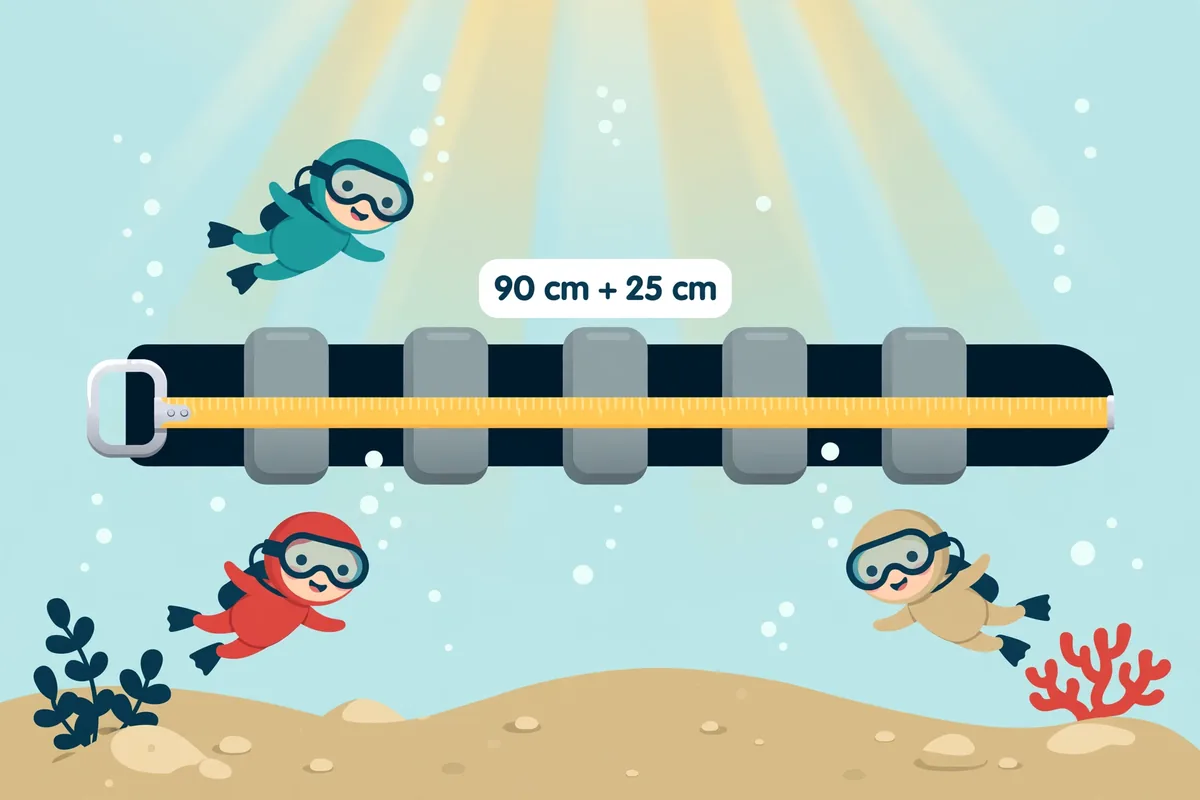
- Add about 25 cm (10 in) for the buckle, the tail and some adjustment.
- Round up to the next belt length available, and make sure the belt is adjustable.
Belt length by waist size
| Waist over suit | Belt length (waist + 25 cm) |
|---|---|
| 70 cm (28 in) | 95 cm (37 in) |
| 80 cm (31 in) | 105 cm (41 in) |
| 90 cm (35 in) | 115 cm (45 in) |
| 100 cm (39 in) | 125 cm (49 in) |
| 110 cm (43 in) | 135 cm (53 in) |
| 120 cm (47 in) | 145 cm (57 in) |
Belts are adjustable, so the “right size” is the one that closes comfortably over your thickest suit and leaves a short tail.
How much does a suit add to your waist?
Neoprene has thickness, and it wraps all the way around you. A suit of thickness t adds about 2πt to your waist circumference, which gives these rough figures:
| Suit thickness | Extra waist circumference (approx.) |
|---|---|
| 2 mm | 1.3 cm (0.5 in) |
| 3 mm | 1.9 cm (0.7 in) |
| 5 mm | 3.1 cm (1.2 in) |
| 7 mm | 4.4 cm (1.7 in) |
That is before compression and before any undergarment. A drysuit with thick undergarments can add several centimetres more, so measure over the real thing. The practical lesson: a belt sized in a 3 mm suit may be too short for a 7 mm one, and a belt sized in swimwear will almost certainly be too short in any suit.
Types of belt
| Type | How it works | Good for | Watch out for |
|---|---|---|---|
| Nylon webbing | A strap with a quick-release buckle | The standard choice; easy to adjust; widely available | Can slide on a compressing suit; needs keepers |
| Elastic or rubber | A stretchy belt that stays snug | Keeps a firm fit as the suit compresses | Check the release is simple and reliable and that the weights cannot shift |
Buckles
The buckle matters more than the belt. It should release with one hand, even while wearing gloves, and it should not release by accident. Stainless steel buckles resist corrosion. Whatever you use, practise the release with your instructor.
Spreading the weight on the belt
Place the weights in equal numbers on each side of the buckle. With six pieces, three go on each side. With an odd number, split as evenly as you can. Keep the weights toward the sides and back rather than bunched at the front, where they can press against the stomach. Fit a keeper or retainer on the outside of each group so the weights cannot slide along the belt. The belt calculator’s diagram shows a typical layout.
Fitting it properly
- Put on the belt last, over your BCD straps and any other equipment, with the buckle in front.
- Pull the tail so that the belt is snug and sits on the hips, not on the ribs.
- Lean, twist and bend. The belt should not shift.
- Check that the tail is short and tucked away.
- In the water, re-check after a minute or two, because suits compress and belts loosen.
Common problems and fixes
| Problem | Why it happens | Fix |
|---|---|---|
| Belt too short | Sized in a thin suit or without a suit | Buy a longer belt or measure over the thickest suit |
| Belt slides down | Suit compression, loose fit, no keepers | Tighten, add keepers, or move weight to pockets |
| Tail snags | Belt too long and loose | Shorten it or tuck the tail under a keeper |
| Back or hip pain | All the lead carried at the waist | Split between belt and BCD pockets |
| Weights press into stomach | Bunched at the front | Spread toward the sides and back |
What to look for when buying a belt
- Enough length for your thickest suit.
- A reliable, one-hand quick-release buckle.
- Keepers or retainers to hold weights in place.
- Webbing that does not stretch or fray, and that handles saltwater.
- Compatibility with your piece size.
Three worked examples
A 70 cm waist in a 3 mm suit
A 3 mm suit adds about 1.9 cm to the waist, so the waist over the suit is roughly 72 cm. Adding 25 cm gives about 97 cm. A belt that adjusts between about 90 and 110 cm would fit well.
A 95 cm waist in a 7 mm suit
A 7 mm suit adds about 4.4 cm, so the waist over the suit is about 99 cm, and the belt length is about 124 cm. This is a good reminder that you should measure over the actual suit: a belt chosen on 95 cm alone would be several centimetres too short.
A 105 cm waist in a drysuit with undergarments
Drysuits and undergarments add more bulk than wetsuits, and the amount varies. Measure over the suit with the undergarment you will wear. If the measurement is 112 cm, the belt should be about 137 cm.
Belt, BCD and harness: what goes on first?
The belt goes on last, over everything else, so that you can reach and release it without anything in the way. If you wear a BCD with a waist strap or cummerbund, the belt sits on top of it, and the same applies to a drysuit inflator hose or any other strap. When you put the kit on, check that nothing passes across the buckle, and that the tail does not get trapped under another strap.
How many weights fit on a belt?
That depends on the belt length and the size of the pieces. Each piece takes up a few centimetres of belt, and you also need to leave space for keepers and the buckle. A longer belt holds more pieces, but you should always keep weights evenly distributed rather than crowding them. If your total lead requires more pieces than fit comfortably, move some into BCD pockets or use larger pieces.
Sizing for smaller divers and youth divers
Smaller waists need shorter belts. A belt that is too long for a smaller diver has a large tail and slides more easily. Choose a belt that can be shortened or one made in a smaller size, and make sure weights are small enough to adjust in fine steps. Always consult the instructor when sizing equipment for young divers.
Looking after your belt
- Rinse the belt and buckle in freshwater after every salt-water dive.
- Dry the belt before storing it, and keep it out of direct sunlight.
- Inspect the webbing for fraying and the buckle for corrosion before every trip.
- Replace a belt that is worn, stretched or has a buckle that sticks.
Key takeaways
- Measure your waist over the suit you dive in, then add about 25 cm (10 in).
- A suit adds about 2πt to waist circumference: roughly 4.4 cm for 7 mm.
- Split weights evenly left and right, with keepers on each side.
- Practise the quick release and check the fit in the water.
Common questions
What is the correct size of a diving belt?
Waist over your suit plus about 25 cm (10 in).
What is the size of the diving belt for a thick suit?
Measure over the thickest suit you dive, because a belt sized for a 3 mm suit may not close over a 7 mm one.
How many weights per side?
Split them evenly. The belt calculator gives the pieces per side.
Should the belt go over or under the BCD?
The belt goes on last, over everything, so that it can be released and ditched without being blocked.
Why does my belt keep sliding down?
Usually because the suit compresses and the belt is not snug. Tighten it, add keepers, or move some lead into BCD pockets.
Can I use a rubber belt?
Some divers do, because it stays snug. Make sure the buckle is simple and reliable, and practise the release.
How long should the tail be?
Short enough not to snag, but long enough to give adjustment. Tuck it under a keeper.
Related calculators
Weight belt calculatorBelt vs integrated weightsScuba weights guideMeasurement guide