The short answer
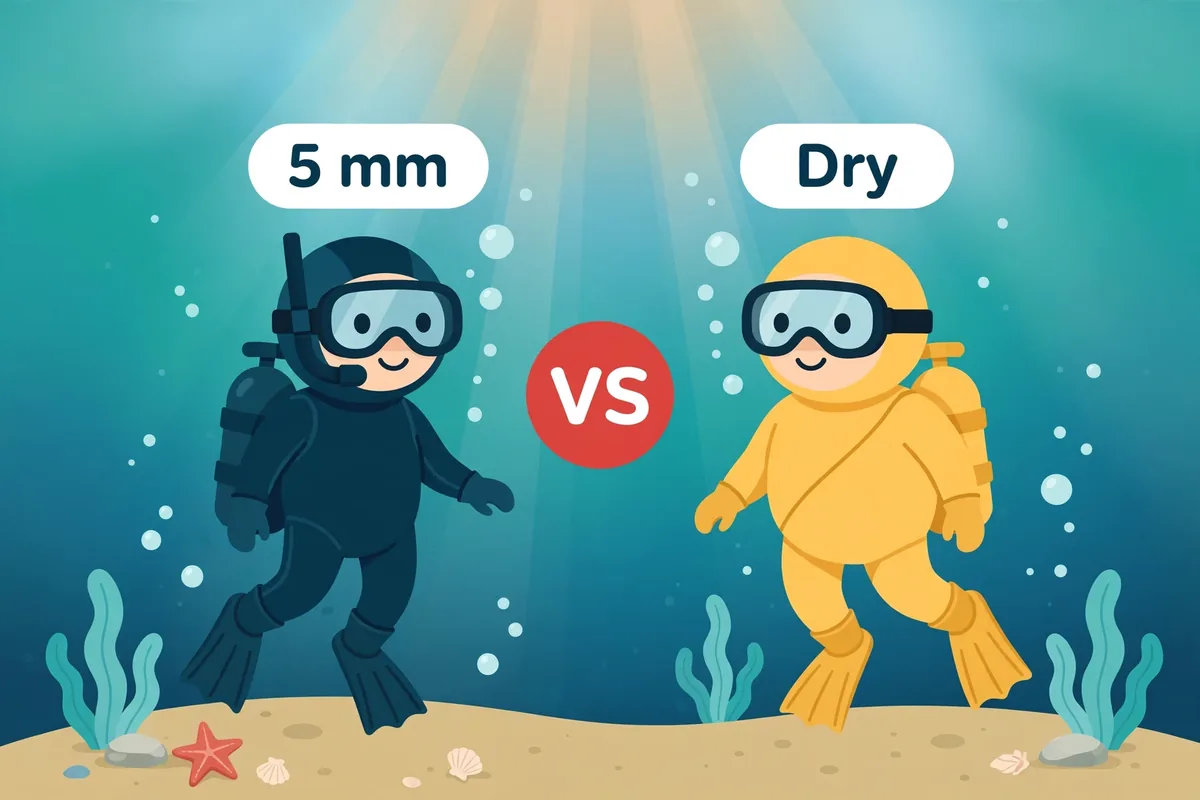
A wetsuit keeps you warm by trapping a thin layer of water against your skin that your body warms up. A drysuit keeps you dry and relies on air and undergarments for insulation. The two feel different, behave differently in buoyancy terms and need different skills. In general a wetsuit is simpler, cheaper and fine for warm and temperate water, while a drysuit is the choice for long or cold dives, and it needs proper training. For weighting, a drysuit usually needs noticeably more lead than a wetsuit: this model adds about 8 kg for a drysuit with undergarment, compared with 4 kg for a 5 mm wetsuit.
How each suit works
Wetsuits
A wetsuit is a close-fitting suit of neoprene, a foam full of tiny gas bubbles. Water seeps in, your body warms it, and the neoprene insulates it. The bubbles make neoprene buoyant, and the thicker the suit, the more bubbles and the more lift. Under pressure the bubbles compress, so a wetsuit’s lift falls with depth.
Drysuits
A drysuit has seals at the neck and wrists (and ankles in some designs) and a waterproof zip. You wear undergarments inside for warmth, and you add a little air through an inflator valve to avoid “squeeze” at depth. The suit itself is thin, and most of its buoyancy comes from the air inside and the undergarments. Air in a drysuit expands as you rise and has to be vented through an exhaust valve.
Lead needed (saltwater, aluminum 80, average build)
| Body weight | 5 mm wetsuit | 7 mm wetsuit | Semi-dry + hood | Drysuit |
|---|---|---|---|---|
| 60 kg (132 lb) | 6.0 kg | 8.0 kg | 9.0 kg | 10.0 kg |
| 80 kg (176 lb) | 6.5 kg | 8.5 kg | 9.5 kg | 10.5 kg |
| 100 kg (220 lb) | 7.0 kg | 9.0 kg | 10.0 kg | 11.0 kg |
Estimates within about 2 kg. Drysuit weighting varies widely with undergarments. Always confirm in the water.
Buoyancy behaviour
Wetsuit
The suit gives most of its lift at the surface and loses much of it as the neoprene compresses. You compensate by adding a little air to the BCD as you descend and venting it as you rise. Weighting is dominated by what the suit does at the surface and at shallow depth.
Drysuit
In a drysuit the air inside behaves like a second BCD. It compresses when you descend and expands as you ascend, so you must add air on the way down and vent it on the way up. That air also moves around the suit: it can float your feet up if you are not trimmed correctly. The consequence is that a drysuit requires more training and practice with buoyancy control, and most agencies offer a dedicated drysuit course.
Warmth and comfort
- Warm water: a thin wetsuit is plenty.
- Temperate water: a 5 mm wetsuit works for many divers; a hood and gloves help.
- Cold water or long dives: a drysuit with undergarments keeps you warmer for longer, and you can adjust warmth by changing the undergarment.
Comfort also depends on you: how long you dive, how much you move, how quickly you get cold and the season. Ask local divers and operators what they recommend.
Skills, safety and training
Diving a drysuit is a skill. You need to learn how to add and vent air, how to control the suit’s buoyancy while swimming and ascending, and how to deal with problems such as air migrating to the feet. A drysuit course with a qualified instructor covers this. A wetsuit requires less specialist training, although good buoyancy control matters with any suit.
Cost, care and convenience
| Factor | Wetsuit | Drysuit |
|---|---|---|
| Initial cost | Lower | Higher, plus undergarments |
| Maintenance | Rinse and dry; neoprene wears | Look after seals, zip and valves |
| Getting dressed | Can be tight and slow | Easy once you know how; needs care with the zip |
| Between dives | You stay wet | You stay dry |
| Travel | Compact | Bulkier |
Weighting a drysuit
- Wear the exact undergarment you will use, and nothing extra.
- Purge excess air from the suit before checking.
- Do a buoyancy check with the tank at about 50 bar.
- Check trim: if your feet float, consider ankle weights or heavier fins.
- Re-check whenever you change undergarments.
Which should you choose?
| Situation | Often better |
|---|---|
| Tropical or warm water | Wetsuit (thin) |
| Temperate water, occasional diver | 5 mm wetsuit |
| Long dives or cold water | Drysuit |
| Diving all year in cool water | Drysuit |
| Limited budget or travel | Wetsuit |
A day with each suit
Wetsuit day
You put on the suit at the dive site, often struggling a little with a thick one. In the water it feels snug and, after a few minutes, comfortable. Between dives you stay wet, and you can get cold on a windy boat. After the dive you rinse it and hang it to dry.
Drysuit day
You put on your undergarment and suit, close the zip (often with help) and check the seals. In the water you add a little air to remove squeeze, and you manage the air as you move up and down. Between dives you stay dry and warm, which is a major advantage in the cold. After the dive you rinse and dry the suit and look after seals, zips and valves.
Common problems
| Suit | Problem | What to do |
|---|---|---|
| Wetsuit | Water flushing through, feeling cold | Check the fit; add a hood, vest or gloves; consider a thicker or better-fitting suit |
| Wetsuit | Hard to get into | Use lubricant or a plastic bag on your feet and hands, and take your time |
| Drysuit | Floaty feet | Adjust trim, add ankle weights or use heavier fins; practise with an instructor |
| Drysuit | Leaks | Check the seals, zip and valves; service the suit; replace worn parts |
| Drysuit | Squeeze at depth | Add a small amount of air as you descend |
Moving from a wetsuit to a drysuit
- Take a drysuit course with a qualified instructor.
- Choose undergarments suited to your water temperature.
- Do your first dives in shallow, calm water.
- Do a fresh buoyancy check, since weighting changes a lot.
- Practise adding and venting air, and controlling your trim.
- Build up to deeper and colder dives gradually.
Semi-dry suits: a middle option
A semi-dry suit is a thick wetsuit with extra seals at the wrists, ankles and neck that slow down water flushing. It is warmer than an ordinary wetsuit of the same thickness, still much simpler than a drysuit, and a popular choice in cooler water. Weighting is close to a thick wetsuit with a hood. See the semi-dry suit calculator.
Thinking about cost
A drysuit costs more up front and needs undergarments, and seals and zips may need replacing over time. A wetsuit costs less but may need replacing more often as the neoprene wears. If you dive in cold water often, a drysuit can be worth it for the comfort, and you can use it for most of the year. If you dive occasionally in warm water, a wetsuit makes more sense.
Key takeaways
- Wetsuits trap water; drysuits keep you dry and rely on air and undergarments.
- A drysuit usually needs more lead, about 8 kg vs 4 kg in this model.
- Drysuit air must be managed on the way down and the way up.
- Get training before diving a drysuit.
Common questions
Do I need more weight in a drysuit than a wetsuit?
Usually yes. The model adds about 8 kg for a drysuit and 4 kg for a 5 mm wetsuit.
Is a drysuit harder to dive?
It adds buoyancy-control skills, so take a drysuit course from a qualified instructor.
Which is better for cold water?
Many divers prefer a drysuit, but the right choice depends on conditions. Ask a local operator.
Why do my feet float in a drysuit?
Air can move to the feet. Adjust your trim, add ankle weights or use heavier fins, and practise with an instructor.
Do I need a different weight for each undergarment?
Yes. Thicker undergarments add lift, so re-check whenever you change them.
Can I use a wetsuit in cold water?
Many divers do with a thick suit, hood and gloves, but long exposure may call for a drysuit.