What buoyancy is
Buoyancy is the upward push that water exerts on anything in it. Whether an object floats, sinks or hovers depends on a contest between two forces: its weight pulling down and the buoyant force pushing up. If the buoyant force is bigger, it floats. If the weight is bigger, it sinks. If they are equal, it hovers, which is exactly what a diver is trying to do. (Buoyancy is sometimes misspelled “bouyancy”, but the physics is the same.)
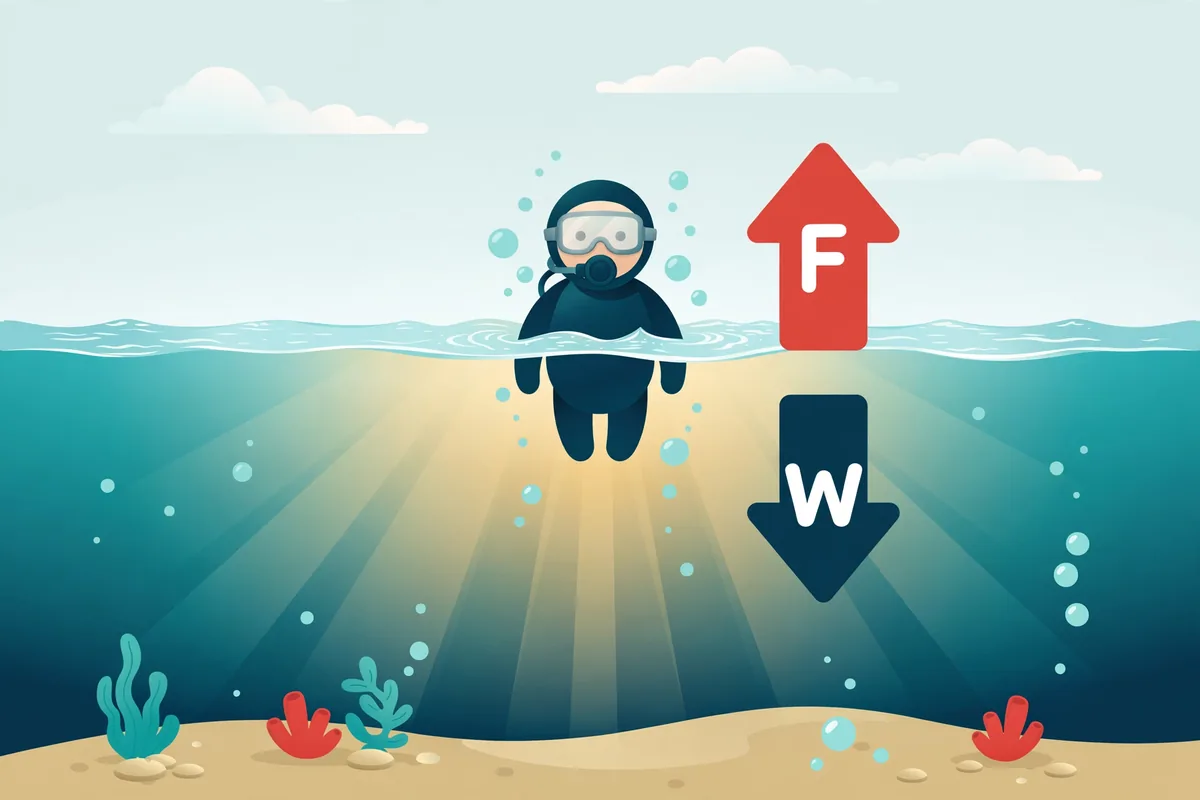
The formula
Apparent weight = mass − (fluid density × volume)
- Fluid density is about 1,025 kg per cubic metre for seawater and 1,000 for freshwater.
- Volume displaced is how much water the object pushes aside. For a fully submerged object it equals the object’s own volume.
- g is gravitational acceleration (9.81 m/s²). It is easier to work in “kg-force”: the buoyant force on 10 litres of seawater is simply 10.25 kg.
- Apparent weight is what the object feels like in water. Positive means it sinks; negative means it floats with that much lift.
The reason this works is explained on the Archimedes’ principle page. To skip the arithmetic use the buoyancy calculator.
Step-by-step method
- Write down the object’s mass (in kg) and volume (in litres).
- Choose the water: 1.025 kg per litre for seawater, 1.000 for freshwater.
- Multiply volume by water density to get the lift in kg.
- Subtract lift from mass. Positive: sinks by that many kg. Negative: floats with that much spare lift.
Example 1: a 12 kg object
A 12 kg object displaces 10 L in seawater. Lift = 10 × 1.025 = 10.25 kg. Apparent weight = 12 − 10.25 = 1.75 kg, so it sinks, but only slightly. In freshwater the lift would be 10.00 kg and the apparent weight 2.00 kg, which shows why things sink a little more easily in lakes.
Example 2: a diver, lungs full and empty
Estimating the volume of a person takes a density. An 80 kg diver of average build has a density of roughly 985 kg per cubic metre with lungs full, so a volume of about 81 L. In seawater the lift is about 83.2 kg and the apparent weight is -3.2 kg. The diver floats with about 3.2 kg of spare lift.
Breathe fully out and the density rises to about 1,050 kg per cubic metre, a volume of 76 L. The lift drops to about 78.1 kg and the apparent weight becomes +1.9 kg: the diver sinks slowly. This is exactly what the buoyancy check relies on. Note that these densities are approximate and vary from person to person, which is why a test in the water is always needed.
Example 3: a scuba tank
A scuba tank is a fixed volume of metal and gas, so its buoyancy changes only because the weight of the air inside changes. A typical aluminum 80 (about 11.1 L water capacity, 14.8 kg with valve) works out at roughly -0.8 kg when full and +1.9 kg when empty in saltwater, where positive means it floats. The air itself weighs about 2.7 kg when the tank is full. Use the tank weight calculator for your own tank.
Example 4: how much a wetsuit lifts at depth
Neoprene is full of gas. Boyle’s law says that doubling the pressure halves the volume of a gas, and every 10 m of seawater adds roughly 1 bar. At 10 m the gas in the suit takes up about half the volume it did at the surface, so the suit displaces less water and lifts less. At 20 m it is compressed further. So a suit that lifts about 4 kg at the surface may lift considerably less at depth. This is why you weight for the surface and the end of the dive, when the suit is least compressed, and why you add air to your BCD as you descend.
Example 5: why BCD air expands as you rise
The same law works in reverse for the air in your BCD. A litre of air at 20 m (3 bar absolute) expands to about 3 litres at the surface. Every extra litre displaces another litre of water and adds about 1 kg of lift, so air in the BCD becomes more buoyant as you ascend. If you are over-weighted you carry more air to compensate, and it expands more.
How to read the result
- Apparent weight positive: the object sinks.
- Apparent weight negative: it floats and the number is its spare lift.
- Near zero: neutral. A real diver never stays exactly neutral, because breathing keeps changing the volume of the lungs.
Common mistakes
- Using weight instead of volume. Lift depends on volume. Two objects of equal weight but different volume float differently.
- Forgetting the water type. Seawater lifts about 2.5 percent more than freshwater.
- Treating the tank as constant. Its weight changes as you breathe the air out.
- Mixing units. Litres and kilograms work together because 1 litre of freshwater has a mass of 1 kg. Pounds and gallons do not, so convert first.
How many pounds of buoyancy do I need in a BCD?
Your BCD must be able to float you at the surface at the start of the dive, when the tank is full. It has to lift the lead you carry plus any gear that is heavier than water, with a margin for safety. Check the lift rating in the manufacturer’s specification for your size and ask your instructor if you are unsure.
Units and conversions
| Quantity | Metric | Imperial |
|---|---|---|
| Mass | 1 kg | 2.2046 lb |
| Volume | 1 litre | 0.264 US gallon, 0.0353 cubic foot |
| Freshwater weight | 1 L = 1.000 kg | 1 cubic foot = 62.4 lb |
| Seawater weight | 1 L = 1.025 kg | 1 cubic foot = 64.0 lb |
The metric system makes buoyancy easy because a litre of freshwater has a mass of exactly one kilogram. In imperial units, use pounds per cubic foot.
An imperial worked example
An object has a mass of 100 lb and a volume of 1.4 cubic feet. In seawater (64.0 lb per cubic foot) the buoyant force is 1.4 × 64.0 = 89.6 lb. The apparent weight is 100 − 89.6 = 10.4 lb, so it sinks. In freshwater (62.4 lb per cubic foot) the lift is 87.4 lb and the apparent weight is 12.6 lb.
Try it at home
You can measure buoyant force directly with a kitchen scale or a spring balance and a bucket:
- Weigh a small, waterproof object (a stone works well) on the scale and note its weight.
- Hang it from a spring balance or string and lower it fully into a bucket of water without touching the sides or bottom.
- Read the new, lower weight. The difference between the two readings is the buoyant force, which equals the weight of the water the object pushed aside.
- Repeat in saltwater. The reading should drop slightly more.
Check your understanding
- A 30 kg object has a volume of 35 L. In freshwater, does it float? Lift 35 kg, weight 30 kg. Yes, with 5 kg of spare lift.
- A 9 kg lead block (volume about 0.8 L) in seawater: apparent weight? Lift 0.82 kg, apparent weight 8.18 kg: it sinks.
- A diver of 70 kg and 69 L volume in freshwater? Lift 69 kg, apparent weight +1 kg: very slightly negative, sinking slowly.
Key takeaways
- Buoyant force = water density × volume displaced × g.
- Compare it with weight: more lift floats, more weight sinks.
- Neoprene compresses with depth and BCD air expands as you rise.
- A tank gets more buoyant as you use the air.
- Use the calculator for the arithmetic and a buoyancy check for the answer that counts.
Common questions
How do you calculate buoyancy?
Multiply the fluid density by the volume displaced and by gravity. Compare that force with the weight of the object to see whether it floats.
How to calculate bouyancy for a diver?
Estimate body volume from weight and density, multiply by the water density, and subtract your mass to get the apparent weight. The buoyancy calculator has a mode for this.
What is the buoyancy calculation for a tank?
Water density times tank volume, minus tank weight plus air weight. The tank weight calculator does this for common tanks.
Why do I float in the sea?
Seawater is denser than fresh water and your lungs hold air, so with a full breath you are lighter than the water you displace.
How many pounds of buoyancy do I need?
Your BCD must lift the lead you carry plus any gear heavier than water, with margin. Check your BCD lift rating.
How much weight does a wetsuit add in lift?
About 2 kg for 3 mm, 4 kg for 5 mm and 6 kg for 7 mm at the surface in this model. It lifts less at depth because neoprene compresses.
Why does air in my BCD expand as I rise?
Pressure falls as you rise, and a gas expands as pressure falls (Boyle’s law). Air at 20 m expands to about three times its volume by the surface.
Is the diver density figure exact?
No. It varies with body composition and with how full your lungs are, so treat it as an estimate and confirm in the water.
Related calculators
Buoyancy calculatorArchimedes principleTank weight calculatorBuoyancy check