What are scuba weights?
Scuba weights, also called dive weights or divers weights, are blocks, bars or bags of lead (or another dense material) that you wear to cancel the buoyancy of your body, your exposure suit and your equipment. They let you descend, hold a safety stop and stay neutral. How much you need is a calculation (start with the scuba weight calculator); this guide is about which kind to use, where to put them and how to use them safely.
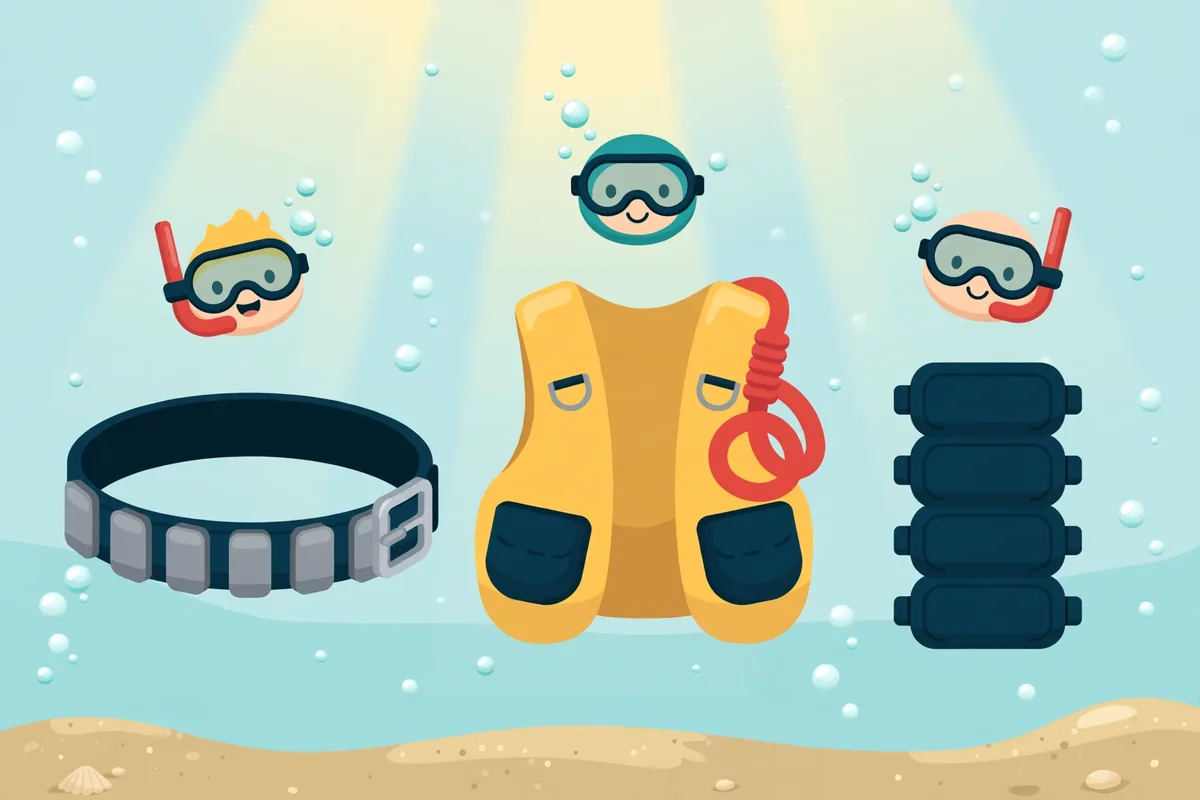
Weights do one job, but how they are carried changes comfort, trim, safety and how easy they are to adjust. That is why there are several systems, and why most divers end up using a mix.
The main types of dive weights
| Type | Where it sits | Good for | Watch out for |
|---|---|---|---|
| Weight belt | Webbing belt at the waist | Simple, easy to adjust and to see; works with any BCD | Can slide down; puts load on the lower back |
| Integrated pockets | Pockets in the BCD | An even, comfortable load; weight stays with the BCD | Needs a compatible BCD; practise releasing both sides |
| Trim weights | Tank band, tank valve area or upper back | Fine-tuning balance so you swim level | Small amounts only |
| Ankle weights | At the ankles | Lifting heavy fins or floaty drysuit feet | Extra drag and leg fatigue |
| Weight harness | Shoulder straps with pockets | Moving load from the waist to the shoulders | Needs a reliable release |
Weight belts
A webbing belt with a quick-release buckle and a set of lead blocks is the oldest and simplest system. It is cheap, universal and easy to adjust piece by piece. Its weaknesses are comfort (all the load sits on the waist) and a tendency to slide down as the wetsuit compresses. A correctly sized belt and a retainer clip on each side help.
Integrated weight pockets
Many modern BCDs have pockets that hold weight pouches or blocks and release them with a handle or buckle. Weight stays high and spread across the sides of the torso, which most divers find more comfortable. The trade-offs are that it only works with BCDs designed for it, and you must know how to release the pockets and make sure they are secure before every dive. See belt vs integrated for a full comparison.
Trim weights
Trim is the angle at which you lie in the water. If your feet sink or your head is too high, moving a small weight to the tank band or the back of the BCD can level you out. Trim weights are for fine adjustment, not for carrying your main lead.
Ankle weights
Divers in drysuits sometimes find that air migrates to their feet and floats them upright. Ankle weights, or sometimes heavier fins, counter that. They add drag and can tire the legs, so they are a fix for a specific problem rather than a default.
Hard lead or soft weights?
| Hard lead blocks | Soft weights (shot in a pouch) | |
|---|---|---|
| Feel | Slim but rigid; can bruise | Moulds to your body |
| Durability | Very durable | Pouch can wear or split |
| Equipment friendly | Can scratch or dent | Gentler on gear |
| Adjusting | In block-sized steps | Often in smaller steps |
| Shifting | None | Shot can move inside the pouch |
Either type works if it stays secure, is easy to release and suits how you dive. Many divers keep hard weights on a belt and soft weights in pockets.
How much does each piece weigh?
Weights come in many sizes. Common pieces are around 1 to 3 kg (2 to 6 lb) each, and some systems use small increments for fine adjustment. Smaller pieces give more flexibility: with 1 kg pieces you can adjust in 1 kg steps, with 2 kg pieces only in 2 kg steps. The belt calculator rounds your total to whole pieces and shows how many go on each side.
How to choose the right system
- Start from your BCD. If it has integrated pockets, they are usually the most comfortable place for the bulk of your lead.
- Think about how much you carry. A few kilograms is easy on a belt. A larger amount is more comfortable split between a belt and pockets, or carried entirely in pockets.
- Choose small pieces. They let you fine-tune weighting and trim.
- Check how easily it releases. You must be able to ditch weight with one hand, wearing everything, without it snagging.
- Think about travel. Weights are heavy to fly with, which is why many divers rent them at the destination. See travelling with dive weights.
Where to place the weight
Weight low on the body tends to bring your legs down, and weight high tends to lift them. Most divers want to lie roughly flat, so weight is spread evenly left and right and shifted slightly as needed. If your feet sink, move weight up or toward the tank. If your legs float, move it down or to the waist or ankles. Change one thing at a time and re-test.
Using weights safely
- Put the belt on last, over everything, with the buckle clear.
- Check clips, buckles, pocket flaps and retainers before every dive.
- Make sure the weights are evenly balanced left and right.
- Never rely on a system you have not released in training.
- Do not drop weights unless there is a genuine need, as trained.
Handling and caring for lead
Lead is toxic if swallowed or inhaled as dust. Wash your hands after handling weights, keep them away from food and children, and never put them near your mouth. Coated weights protect against contact and dents. Rinse weights in freshwater after salt dives, dry them, inspect coatings for chips and replace damaged pieces. When weights wear out, take them to a recycling or hazardous waste point rather than the bin. More in lead dive weights: safe handling and care.
Frequently confused things
- Weighting vs buoyancy control. Weights set your base neutrality; your BCD and breathing fine-tune it during the dive.
- Weight vs lift. Your BCD lift rating is how much it can float; weights are what it has to lift at the surface. See the weight limit guide.
Weight systems by diving style
- Warm-water boat diving: small amounts of lead, so a simple belt or a couple of pockets is plenty. Light and easy to rent.
- Cold water and drysuits: larger amounts, so integrated pockets (or a split between pockets and belt) spread the load. Trim weights or ankle weights may be needed for balance.
- Shore diving: you carry everything over uneven ground, so a comfortable, secure system matters. Integrated pockets or a harness reduce back strain.
- Travel diving: most divers rent weights at the destination and bring only a retainer clip or a small trim weight.
- Training and pool sessions: the instructor usually supplies weights and checks that you are weighted correctly.
Setting up a weight belt properly
- Slide the weights onto the belt in equal numbers on each side of the buckle.
- Fit a retainer clip or keeper on the outside of each group so the weights cannot migrate.
- Put on your exposure suit and fasten the belt over it. It should be snug without squeezing.
- Check that the buckle sits at the front, in your hand’s natural reach, with nothing across it.
- Lean forward and twist. The belt should not slide or slip down your hips.
- After a few minutes in the water, re-check the fit, because wetsuits compress and belts loosen.
Setting up integrated pockets
- Put equal weights in the left and right pockets unless you are intentionally compensating for trim.
- Seat each pouch fully and close the flap or fastener.
- Find the release handles by feel. You should be able to reach both with your eyes closed.
- Practise the release in shallow water or a pool, ideally with an instructor, until it is routine.
- Re-seat and secure the pockets after any release.
What to look for when buying
- Coating quality: a tough coating reduces dents, scratches and direct contact with lead.
- Size options: several piece sizes give you finer adjustment.
- Buckle reliability: a stainless buckle with a simple, one-hand release.
- Retainers or keepers: they stop weights from sliding along a belt.
- Pouch construction: strong stitching, a good closure and drainage for soft weights.
- Compatibility: make sure pockets, pouches and your BCD match.
Common problems and fixes
| Problem | Likely cause | Fix |
|---|---|---|
| Belt slides down | Suit compresses; belt too loose or too short | Tighten, add a keeper, or move weight to pockets |
| Feet sink | Weight too low or too far back | Move lead higher or toward the tank |
| Feet float | Floaty fins or drysuit air in the feet | Weight at the ankles or lower on the body |
| Lower-back ache | All the lead on a belt | Move some into pockets or a harness |
| Weights shift in pouch | Loose soft weights | Use a snug pouch or hard blocks |
| Hard to release | Strap over buckle; pocket not seated | Re-route, re-seat and practise the release |
Key takeaways
- Dive weights offset buoyancy so you can descend and hold neutral.
- Belts are simple; integrated pockets are comfortable; trim and ankle weights fine-tune.
- Choose small pieces and a system you can release with one hand.
- Practise the release, check it before every dive, and handle lead safely.
Educational guide. Learn to use your weighting system with a certified instructor.
Common questions
What do scuba weights weigh?
They come in many sizes, commonly pieces of around 1 to 3 kg (2 to 6 lb). Check what your dive shop sells.
Are belt weights or integrated weights better?
Neither is better for everyone. Belts are simple and universal; integrated pockets are more comfortable. Many divers use both.
How many scuba weights do I need?
Find your total with the calculator, then divide by your piece size. The belt calculator does this and splits it left and right.
What are ankle weights for?
Mainly for divers whose feet float, such as some drysuit divers, or who use heavy fins. They add drag, so use them to fix a specific problem.
Are soft weights better than hard lead?
They are more comfortable and gentler on equipment, but the shot can shift and pouches wear. Hard lead is durable. Choose what suits how you dive.
Do I need weights in a pool?
Often for training. You may need less with a steel or nearly empty tank. Check with your instructor.
Can I fly with dive weights?
Airlines have their own baggage rules, and many divers rent weights at the destination. Check with your airline and dive centre.
Is lead dangerous to handle?
It is toxic if swallowed or inhaled as dust. Wash your hands afterwards and keep weights away from food and children.
Related calculators
Belt vs integrated weightsWeight belt calculatorDiving belt sizeHow much weight do I need?